When a basement waterproofing contractor recommends one approach over another, it's worth understanding the trade-offs yourself. Sometimes the recommendation is right. Sometimes it's based on what the company prefers to sell, not what your house needs.
Here's the honest version of when each approach makes sense, what they actually do, and how to push back if a quote doesn't feel right.
What "waterproofing" actually means in each approach
Both methods solve basement water problems. They go about it differently.
Interior waterproofing
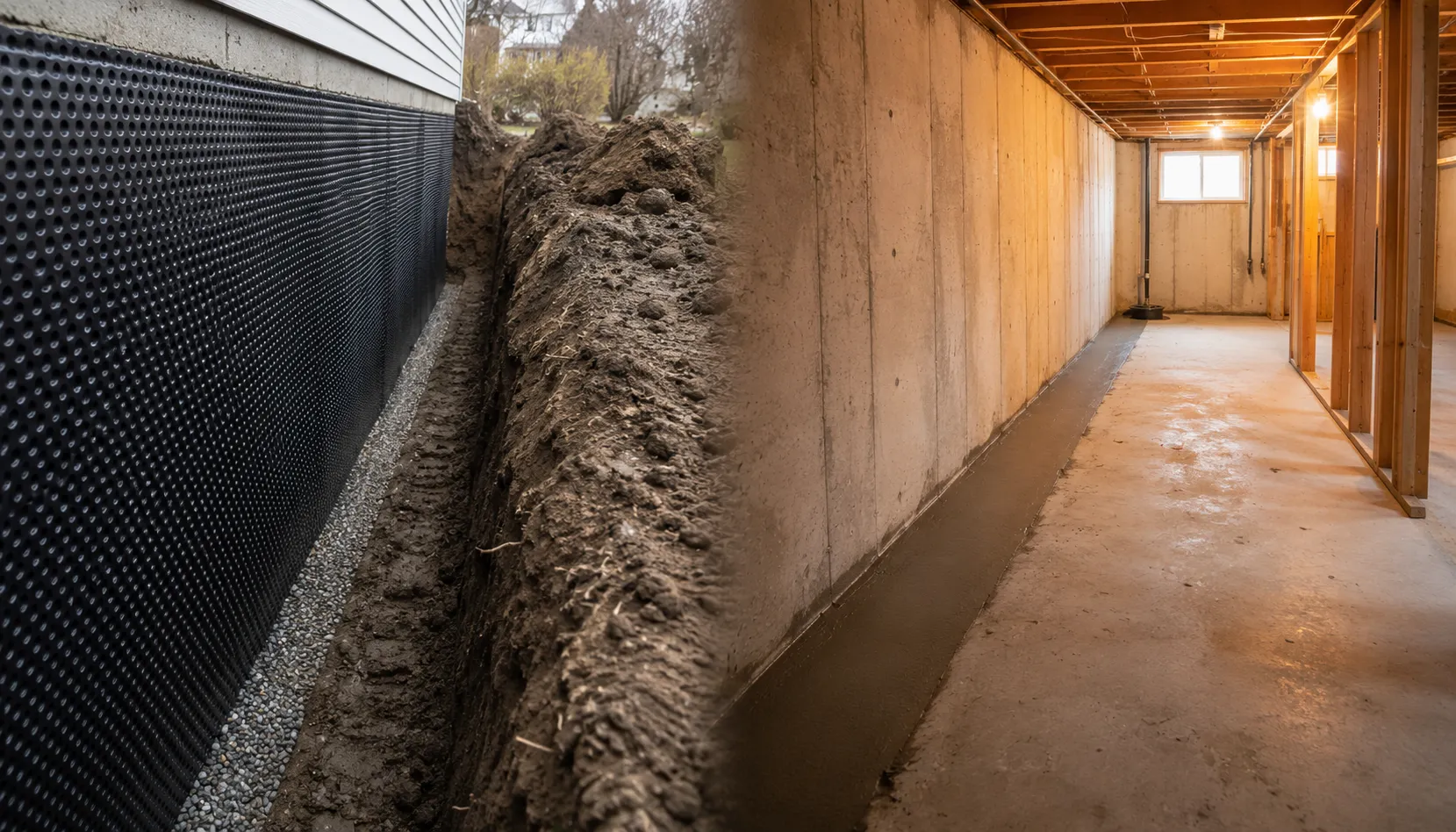
You install a drainage system inside the basement. A trench is cut along the perimeter of the floor, weeping tile is installed, water is collected and pumped out via a sump system. Water still gets through the foundation wall - but now it has somewhere to go before it ever reaches your floor.
Exterior waterproofing
You excavate down to the footing on the outside of the house, apply a new waterproof membrane to the foundation wall, replace the exterior weeping tile, and backfill. Water never reaches the foundation wall in the first place.
When interior is the right choice (most cases)
- You want the cheaper, faster fix (and it's usually plenty)
- You don't want to dig up landscaping, decks, or driveways
- You have multiple seepage points along the perimeter (not just one localized issue)
- Your existing exterior weeping tile has clogged or failed (common at 30+ years)
- Your foundation walls themselves are sound (no major structural concerns)
- You're working with a finite budget ($7K-$12K for full perimeter vs $20K-$28K)
When exterior is the right choice
- Your foundation has structural concerns (bowing wall, large horizontal cracks)
- You want a permanent fix that treats the source, not the symptoms
- Your house is 50+ years old and the original membrane has failed completely
- You're already excavating for landscaping or driveway work
- Hydrostatic pressure is severe enough that interior systems would run constantly
- You can afford the higher upfront cost ($15K-$30K) and the disruption
The trade-off table
Side by side:
Cost
Interior: $7,000-$15,000. Exterior: $15,000-$30,000+.
Time
Interior: 2-4 days, weather-independent. Exterior: 7-14 days, weather-dependent.
Disruption
Interior: dust and noise inside the house, but landscaping untouched. Exterior: massive excavation outside, anything within 4-6 feet of foundation comes out.
Warranty / lifespan
Both: 25-30+ years if installed correctly. Modern membranes outlast original installations significantly.
Effectiveness
Both fully solve the symptom (water in basement). Exterior also solves the cause (water against foundation). For most homeowners the symptom is what matters.
Combined approaches
Some jobs use both. If you're excavating for exterior work anyway, adding interior weeping tile + sump as a backup system is a relatively small additional cost ($3K-$5K) and gives you redundancy. Insurance for the rare case where a future exterior membrane failure happens.
Questions to ask any contractor recommending one approach
- Why this approach over the other for my specific situation?
- What are the specific water sources you identified during inspection?
- Is my foundation wall structurally sound or are there concerns?
- What's the cost difference and what do I actually get for it?
- What warranty do you offer and is it transferable?
Honest answers to these questions are themselves useful signals. A contractor who can explain the trade-offs in plain language probably knows their work. A contractor who insists their preferred method is the only option, or who can't explain the trade-offs, is selling.
Free inspection, honest recommendation
We do interior, exterior, and hybrid jobs. We pick whichever fits your situation - not whichever is easier to sell. Free inspection. Plain-language quote.
Got a basement waterproofing question?
Free inspection across Newmarket and York Region. Honest answers, no sales pressure.
Call (289) 212-5404