What basement waterproofing actually means
"Basement waterproofing" is a catch-all phrase for the work needed to keep water out of your basement. The right work depends on where the water is coming from, the age of your foundation, the soil around your house, and your budget. There is no one-size-fits-all method, despite what some companies will tell you when they show up trying to sell you a $20,000 system.
What we do at Newmarket Basement Pros is figure out which problem you actually have, then recommend the smallest, most durable fix. Sometimes that is a $500 polyurethane crack injection. Sometimes it is a full interior weeping tile system. We won't quote you a system you don't need.
The signs your basement needs waterproofing
Most homeowners notice one or more of these before they call us:
- Damp patches or wet streaks on basement walls after rain or thaw
- White chalky residue on concrete (efflorescence - mineral deposits left as water evaporates)
- Musty smell that does not go away even with a dehumidifier running
- Visible cracks in foundation walls, especially horizontal or stepped cracks
- Peeling paint or bubbling drywall at the bottom of basement walls
- Water pooling on the basement floor after heavy rain
- Sump pump running constantly or running when it is not even raining
- Mould growth behind furniture, in corners, or on stored items
If you have any of these, schedule an inspection before drywall, finishes, or stored belongings hide a problem that gets more expensive the longer it sits.
The four main waterproofing methods
1. Foundation crack injection
For poured concrete foundations with an active or seeping crack. We inject high-pressure polyurethane (or epoxy, depending on whether the crack is structural) into the crack from inside the basement. The injection fills the crack from front to back and bonds permanently. Takes 1-2 hours per crack. Often the simplest and cheapest fix when the problem is one crack, not a system failure. Learn more about foundation crack repair.
2. Interior waterproofing (weeping tile + sump pump)
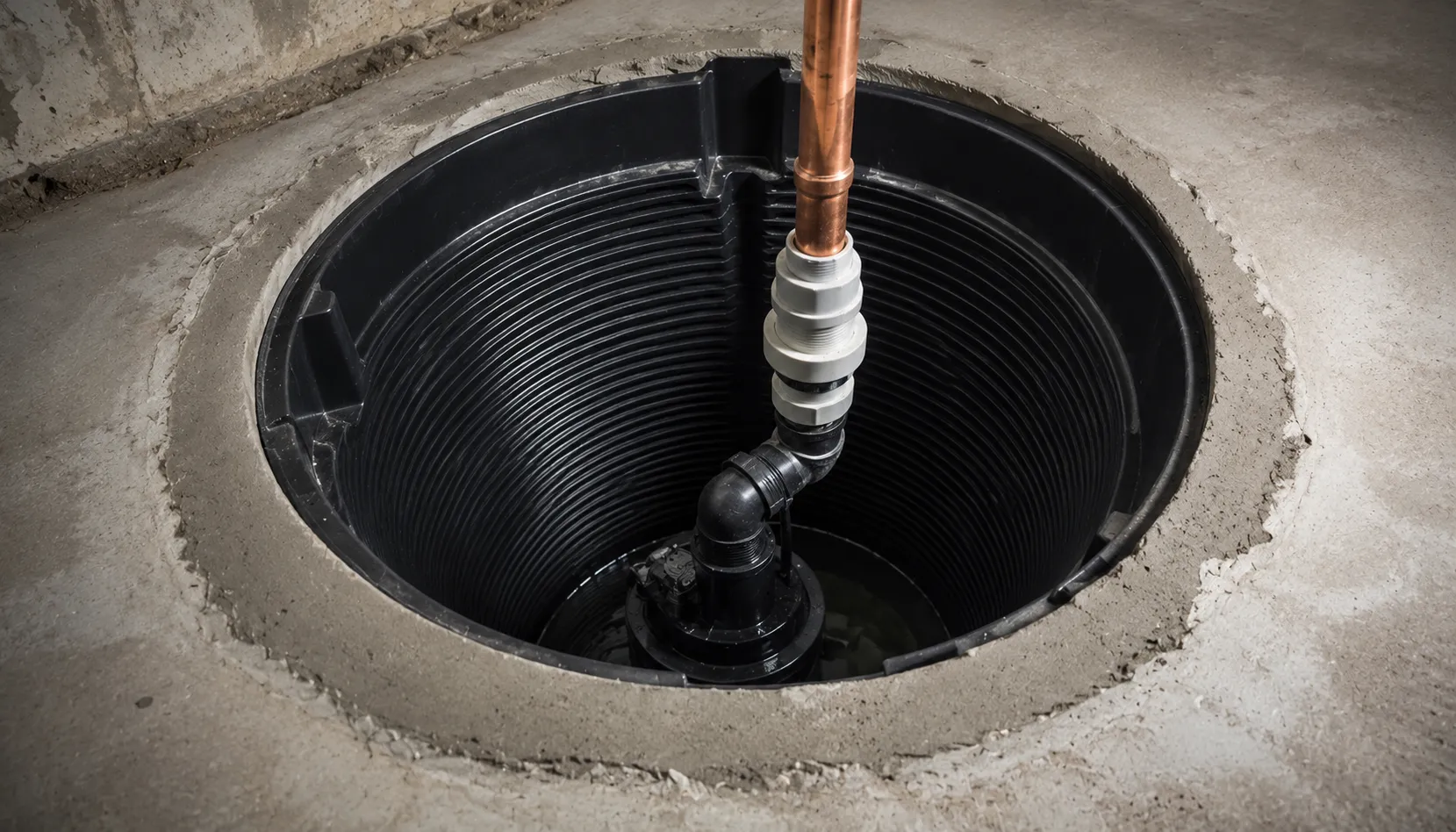
For multiple seepage points, perimeter water issues, or aging weeping tile. We jackhammer a trench around the inside perimeter of the basement floor, install new weeping tile, connect it to a sump pit and pump that ejects water outside, then re-pour concrete over top. Less expensive than exterior. Faster. Doesn't disturb landscaping, decks, or driveways. Learn more about interior waterproofing.
3. Exterior waterproofing
For severe water issues, structural concerns, or when the original exterior membrane has failed. We excavate down to the footing, clean the foundation wall, apply a new waterproof membrane, install or replace the exterior weeping tile, and backfill. More expensive. More disruptive. But it stops water at the source rather than managing it. The right call for some homes. Learn more about exterior waterproofing.
4. Targeted repairs (window wells, tie-rod holes, etc.)
Sometimes the issue is local: a window well filling with water, a leaking tie-rod hole, a damaged downspout drain. These are smaller jobs with smaller price tags. Don't let anyone sell you a $15,000 system to fix what should be a $400 repair.
What an inspection looks like
We come to your home. We look at the inside walls, the outside grading, the downspouts, the window wells, the sump pump (if you have one), and the soil. We ask questions about when the leaks happen and what the conditions are. Then we tell you, in plain language, what we think is going on and what it would cost to fix it.
If we don't think you need anything, we tell you that too. The inspection is free either way.
Newmarket-specific considerations
Newmarket has a mix of housing eras that each bring their own basement issues:
- Pre-1970s homes (Old Newmarket, near Davis Drive and Main Street) often have stone or block foundations with no original waterproofing membrane. Interior waterproofing is usually the practical fix.
- 1970s-90s subdivisions (Glenway, Stonehaven) have poured concrete foundations whose original tar membranes have started to fail at the 30-50 year mark. Crack injection or partial exterior re-membrane is common here.
- Newer builds (Copper Hills, Summerhill Estates) are usually fine but show occasional issues with shifted weeping tile or window well drainage.
York Region's clay-heavy soil holds water against foundations, which is why local hydrostatic pressure issues are more common here than in sandy-soil regions. We design solutions with that in mind.
Get a free inspection
Call us or fill out the form. We'll get back to you to book the on-site visit and the written quote.