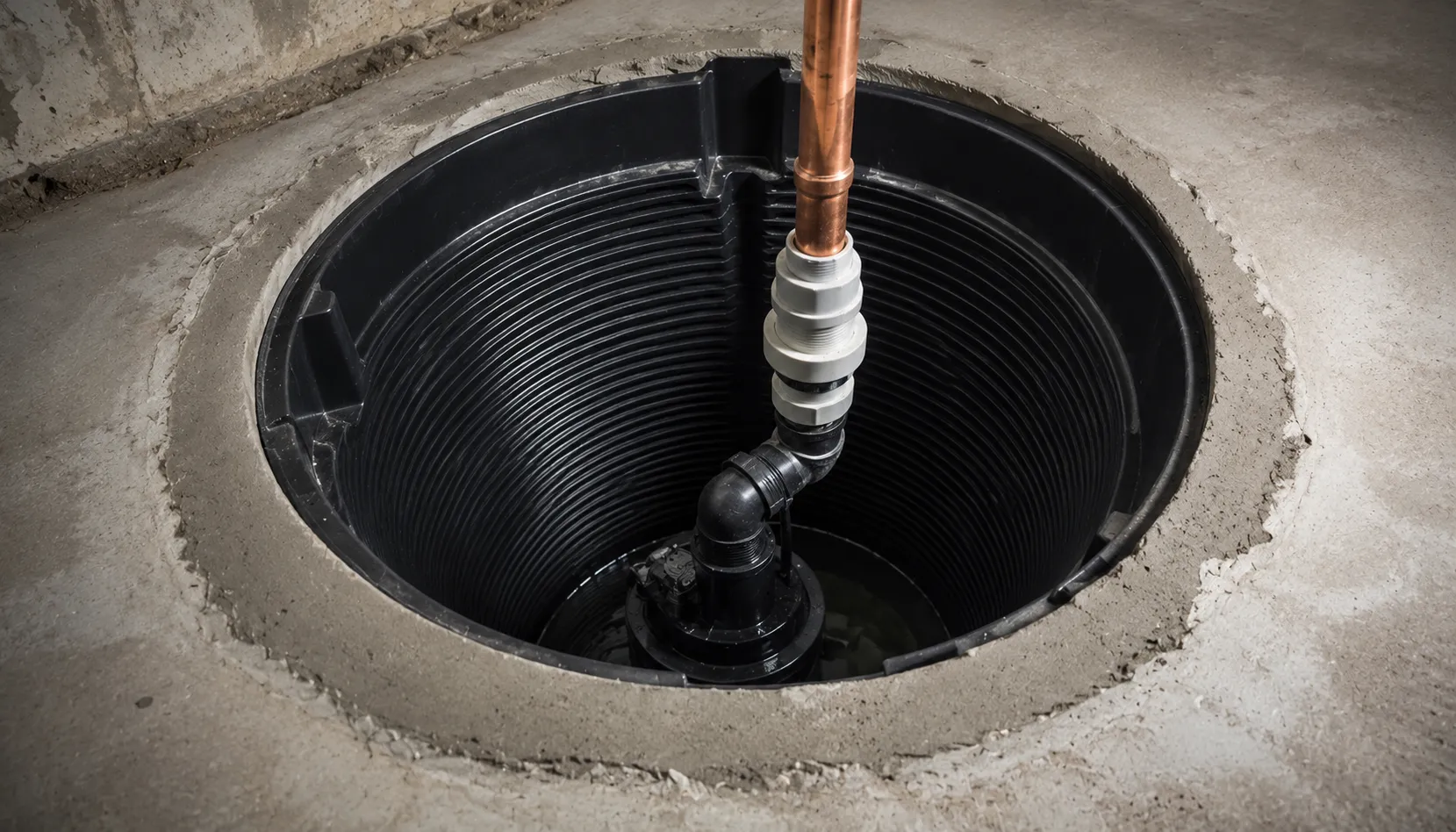
How interior waterproofing works
Picture the inside perimeter of your basement floor. We jackhammer a 12-inch-wide trench along that perimeter, going down to the footing. We install new perforated weeping tile (drainage pipe) in the trench. We connect that pipe to a sump pit dug at the lowest point. A sump pump in the pit ejects collected water through a pipe to outside the house. We re-pour concrete over the trench. The system is invisible afterwards.
Water that gets through your foundation wall now has nowhere to go but into the new drainage system. From there it pumps out before it ever touches your basement floor. No more puddles. No more wet drywall. No more musty smell.
When interior is the right choice
- You have multiple seepage points along the perimeter, not just one crack
- Your existing exterior weeping tile has failed (common at 30+ years)
- You can't or don't want to dig up your landscaping, deck, or driveway
- You want a faster install (2-4 days vs 1-2 weeks for exterior)
- Your budget is $7,000-$12,000 not $15,000+
- The water pressure isn't extreme enough to require exterior treatment
What the install looks like, day by day
Day 1: Trench cut. We jackhammer the perimeter and remove the concrete and soil. Dust containment plastic seals off the work area from the rest of the house.
Day 2: Weeping tile installation. New perforated pipe goes into the trench, surrounded by clean gravel. Sump pit is set into the lowest corner. Sump pump is wired into a dedicated circuit (we coordinate with an electrician if your panel needs work). Discharge pipe is run to outside.
Day 3: Concrete pour. We pour fresh concrete over the trench and finish smooth. The strip is slightly visible for a year or two, then cures to match the existing floor.
Day 4: Final clean-up, system test, walk-through. We run water into the system to confirm it pumps correctly. We show you how to test the pump and replace the battery backup.
Battery backup and high-water alarms
Most basement floods happen during big storms - and those storms often knock out power. A standard sump pump is useless during a power outage. We strongly recommend a battery backup pump that kicks in automatically when the primary fails or when power goes out. Add a Wi-Fi-connected high-water alarm and you'll get a phone notification if the water level rises above the pump's threshold. Total upgrade is usually $1,200-$1,800 and has saved many of our clients five-figure repair bills.
What it looks like in a Newmarket home
An average Newmarket bungalow with a 1,200 sq ft basement and 140 linear feet of perimeter is a 3-day job at $9,000-$11,000 including a battery backup pump. A larger two-story with a 2,000 sq ft basement and 200 linear feet of perimeter runs $12,000-$15,000.